

Transforming Integrated Marketing Planning at Sur La Table
Building a More Agile, Customer-Led GTM Organization
Overview
As Sur La Table evolved toward a more customer-led and brand-driven marketing organization, it became increasingly clear that legacy planning processes were limiting agility, alignment, and storytelling consistency across channels.
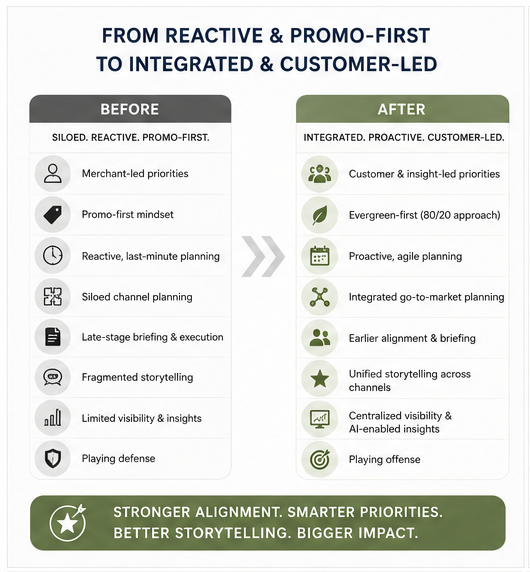
Historically, marketing planning operated within a highly promotional, merchant-led structure that emphasized reactive execution and siloed channel planning. Teams were often playing defense instead of proactively building integrated customer experiences.
To support the company’s evolving brand direction and future growth ambitions, I partnered with Brand leadership to help redesign the Integrated Marketing and Go-To-Market planning process. The goal was not simply to create a better calendar. It was to fundamentally improve how the organization aligned around customer storytelling, prioritization, operational readiness, and integrated campaign execution.
The philosophy behind the transformation became:
“You don’t have to get ready if you’re always ready.”
By building a stronger evergreen planning foundation, the organization could become more agile, responsive, and culturally relevant without sacrificing operational stability.
The Business Challenge
Before the transformation, planning was heavily driven by promotional urgency, merchant requests, and reactive execution cycles. Channel teams operated independently, resulting in inconsistent storytelling, late-stage briefing, operational strain, and limited visibility across the broader marketing ecosystem.
Several organizational realities compounded the challenge:
Planning was highly siloed across channels and departments
Campaign prioritization lacked consistent financial rigor
Teams were often reacting to business needs instead of proactively shaping them
Downstream teams were brought into planning too late
Legacy operational processes limited agility and integration
Leadership expectations for transformation were moving faster than organizational readiness
At the same time, the business still needed to deliver against day-to-day promotional and commercial goals while building the future-state model simultaneously.
One of the most important leadership lessons throughout the process was recognizing that integrated marketing transformation cannot happen overnight. Legacy business needs still have to operate while future-state systems are being built.
My Role
I partnered closely with the VP of Brand Marketing to help design and operationalize the future-state Integrated Marketing and GTM framework.
While aligned to a shared strategic vision, I independently led many aspects of the transformation initiative, including stakeholder meetings, operational rollout, organizational alignment, and change management efforts across cross-functional teams and leadership groups.
My responsibilities included:
Collaborating on the future-state integrated planning framework
Facilitating alignment across Marketing, Merchandising, Retail, Operations, and channel teams
Leading change management efforts across siloed organizations
Building prioritization and campaign planning frameworks
Developing executive reporting and integrated visibility tools
Implementing AI-enabled workflows to improve operational efficiency
Influencing operational process improvements without direct authority ownership
Driving leadership communication and stakeholder alignment throughout the rollout
Strategic Approach
The transformation centered around moving the organization from reactive promotional planning toward a more balanced and customer-led model grounded in evergreen storytelling, operational readiness, and financial prioritization.
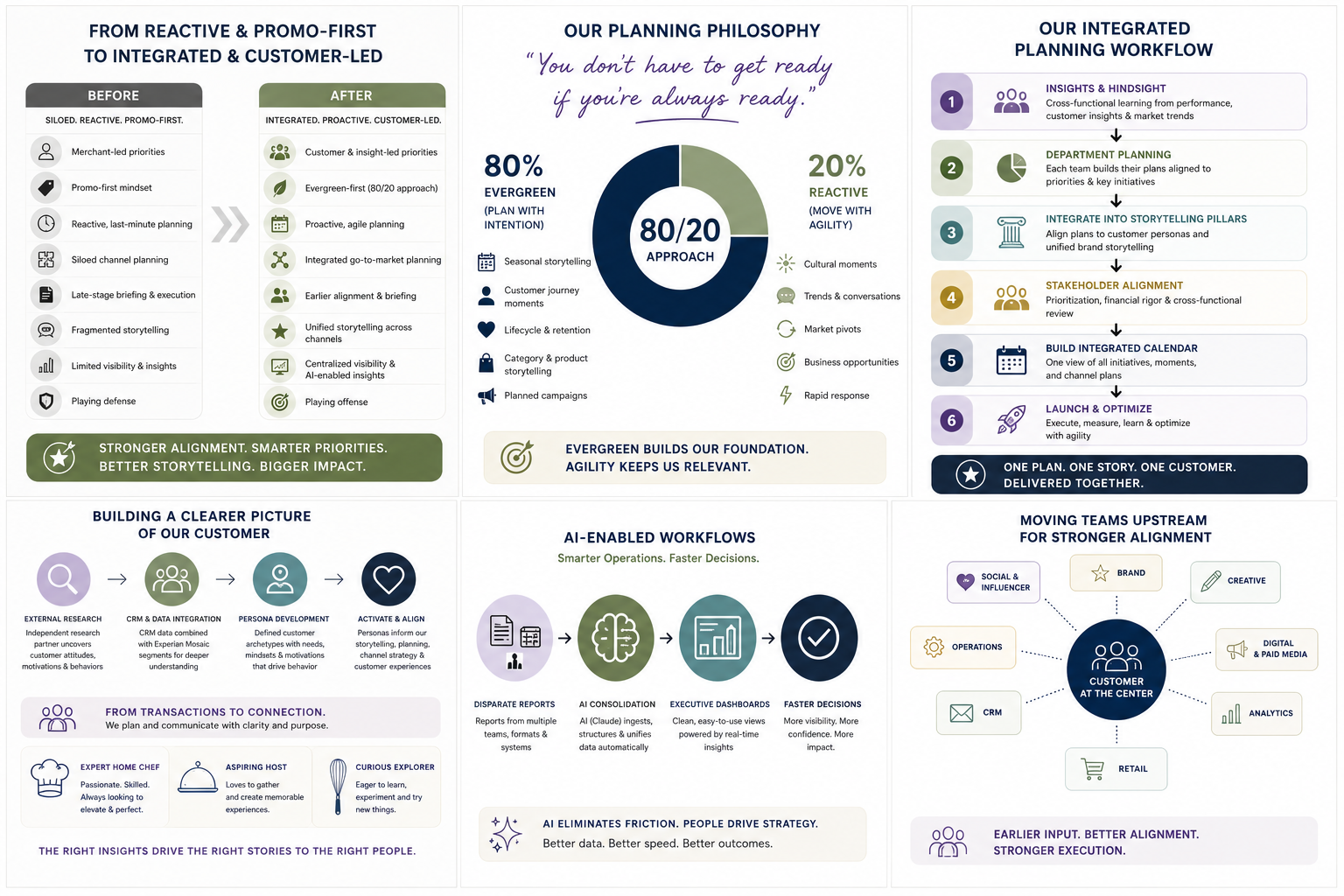
The long-term vision was to create an 80/20 planning approach:
80% evergreen, proactively planned storytelling and customer engagement
20% reactive flexibility for cultural moments, business pivots, and emerging opportunities
To support this shift, several foundational systems and frameworks were introduced:
Prioritization Framework
Rebuilt campaign prioritization models to move beyond legacy tiering systems and incorporate stronger financial rigor, category importance, and strategic business impact.
Exclusive Product Marketing Framework
Developed a scalable tiering model for exclusive products that empowered Merchandising teams to move more quickly in-market without relying on manual marketing approvals for every opportunity.
Formalized Hindsight Process
Introduced structured hindsight and retrospective planning sessions to consolidate insights across teams and improve future decision-making.
Integrated Planning Workflow
Created a more connected planning process that moved downstream team involvement earlier into strategic planning conversations, improving alignment and reducing late-stage rework.
Customer Insight & Persona Development
A foundational component of the transformation involved redefining how the organization understood and spoke to its customer.
Using research conducted through an external insights partner alongside CRM and Experian Mosaic segmentation data, I helped develop more refined customer personas grounded in behavioral insights, lifestyle patterns, and emotional motivations rather than solely transactional performance.
These personas helped shift planning conversations from “What are we promoting?” to “Who are we speaking to, and why does this matter to them?”
The work became an important catalyst in evolving the organization toward more customer-led storytelling, stronger audience alignment, and a more emotionally resonant brand voice across campaigns and channels.
AI-Enabled Operational Workflows
Implemented AI-supported briefing and reporting workflows that accelerated planning speed, simplified executive reporting, and improved operational visibility across teams.
One of the most impactful operational improvements involved leveraging AI tools to consolidate disparate reporting formats into centralized executive dashboard views without requiring teams to abandon existing workflows. This allowed the organization to improve visibility and decision-making without creating unnecessary operational friction.
Execution & Rollout
The transformation process required balancing long-term operational change with the realities of running a fast-paced retail business.
The rollout followed a phased approach:
Cross-functional hindsight and insight gathering
Department-level planning alignment
Integration of plans into unified storytelling pillars
Stakeholder review and prioritization alignment
Development of centralized integrated calendar views
Organizational rollout and adoption
A major challenge throughout execution was building trust and buy-in across teams without direct authority ownership. Success depended heavily on relationship-building, transparency, and creating alignment around shared business goals rather than forcing compliance through hierarchy.
The initiative also required making strategic decisions independently and confidently while maintaining leadership alignment through ongoing communication and shared vision checkpoints.
Results
While the transformation remains an evolving long-term initiative, the work delivered meaningful organizational improvements and established the operational foundation for future integrated marketing growth.
Key outcomes included:
Earlier planning alignment across teams and stakeholders
Improved financial rigor in campaign prioritization
Stronger cross-functional collaboration and visibility
More integrated customer storytelling across channels
Faster briefing and reporting workflows through AI-enabled processes
Increased operational agility and readiness for reactive opportunities
Improved executive visibility into marketing priorities and initiatives
Established foundational infrastructure for future integrated marketing scaling
Most importantly, the initiative helped shift organizational thinking away from purely promotional marketing toward a more balanced model where storytelling and customer connection became equally important components of the brand experience.
Key Takeaways
Integrated marketing transformation is not simply a process change. It is an organizational behavior change.
One of the most important lessons from this work was recognizing that leadership is not about personally compensating for every operational gap. Sustainable transformation requires acknowledging capability limitations, building systems that support teams more effectively, and focusing energy on the areas where influence creates the greatest long-term impact.
This initiative reinforced that successful integrated marketing requires more than coordination. It requires trust, operational clarity, financial prioritization, and a shared customer vision across every function involved in the customer journey.
Most importantly, it demonstrated that strong evergreen planning creates the flexibility organizations need to respond quickly, stay culturally relevant, and operate more strategically over time.